What to Expect in Your Go-Live Log Review
Last updated: July 10, 2026
This guide explains what we evaluate during a go-live API log review and what you should have in place before submitting for review.
Our goal is to identify inefficiencies that could affect your integration's performance or reliability in production after go-live, for both your system and ours.
What we evaluate
Webhooks
If your integration uses webhooks, we verify that the relevant types are enabled and being successfully delivered to your system.
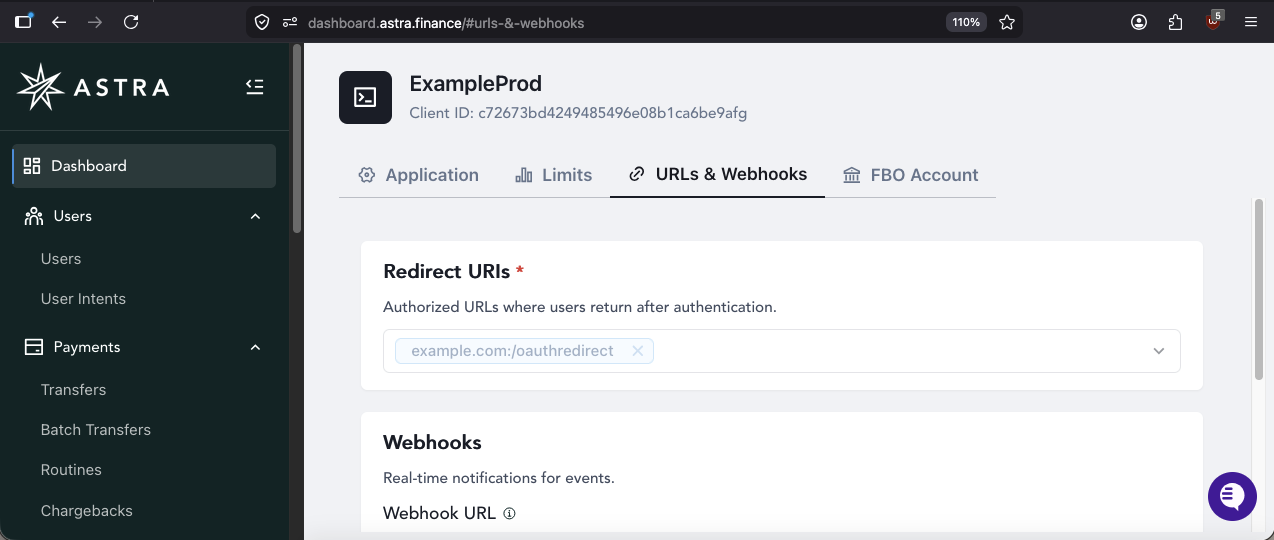
We look for evidence that your system is consuming webhook events and responding to them appropriately. For example, performing a GET request on the relevant resource after receiving an update event.
If your integration relies on webhooks and there are failed deliveries with HTTP errors, we'll raise that as an issue.
For guidance, see Webhooks.
Token management
We review how your application handles token issuance and reuse.
Tokens should be requested once and reused for their full valid lifetime. We look for implementations that cache the current token and only request a new one after the existing token has expired. Generating a new token before each API request is considered an inefficiency.
For guidance, see Managing the Authorization Lifecycle.
Polling
We assess whether your application relies on excessive or unnecessary polling.
A common example is fetching user details before every API request. We recommend caching user details locally and refreshing only when a user_updated webhook is received. Patterns like this, if unaddressed, can create unnecessary API load.
Polling is often a sign that webhook events aren't being consumed. GET requests should generally only be happening following a relevant webhook. If lots of polling unrelated to webhooks is present, we'll evaluate whether its frequency and scope are reasonable.
Polling can serve as a fallback mechanism when webhooks fail. For example, if your system doesn't receive a webhook for a card-to-card transfer, you can use the following approach:
Add logic to detect when a card-to-card
transfer_idhasn't reached a terminal state after 8 hours.Call the transfer details endpoint for that
transfer_idto fetch the latest status.
This polling approach ensures you can retrieve status updates when webhook delivery fails.
Secure endpoint usage
We verify that your integration is using the correct base URL for each resource.
Most API requests should use the standard production base URL:
https://api.astra.financeThe following resources require the secure endpoint and should be called accordingly:
Resource | API reference | Secure endpoint |
|---|---|---|
|
| |
|
|
Using the secure endpoint for requests outside of these resources is flagged as an issue. For a full overview of available endpoints, see the API reference.
User intent data
Applies only if personal verified users are part of your flows.
We review user intent data for completeness and accuracy:
No misplaced values (for example, a first name entered in the
street_1field)Values are distinct across unique individuals
If your integration is not KYC delegated, last 4 SSN and date of birth are required where applicable. These fields are optional for KYC-delegated integrations.
IP address must correlate to the user address. Do not test with proxies or local IPs.
For go-live review, you must use real user intent data. Do not use placeholder or "dummy" data for your user intent values.
For guidance, see Create a User Intent and User Webhooks Reference.
Anomalous activity
We flag anything that appears unnecessarily repetitive, inefficient, or unexpected.
Review summary
At the close of every review, we summarize our findings and call out anything that should be addressed before go-live. Our aim is to protect both your integration and our infrastructure from issues that would create operational burden down the line.