Card-to-Card Transfers: Automatic AFT Reversals on OCT Failures
Last updated: October 30, 2026
A card-to-card (C2C) transfer moves funds in two steps:
AFT (Account Funding Transaction) that pulls funds from the source card
OCT (Original Credit Transaction) that pushes those funds onto the destination card
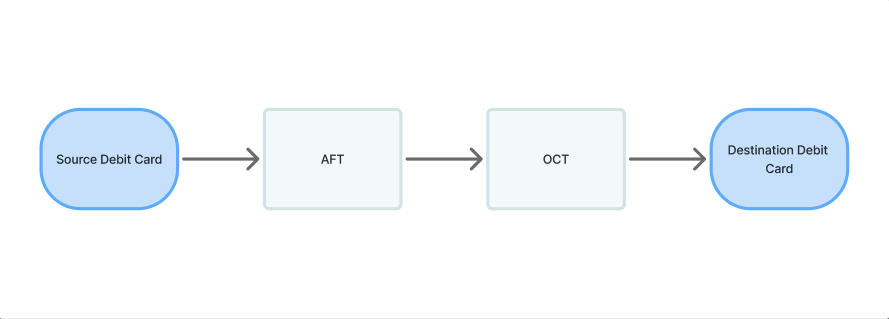
If the AFT succeeds but the OCT fails — for example, the destination card is inactive, closed, or otherwise can’t accept funds — Astra automatically reverses the AFT.
This returns the funds to the source card right away, so the sender isn’t left without their money, and it removes the risk of a chargeback from funds that never reached the destination card.
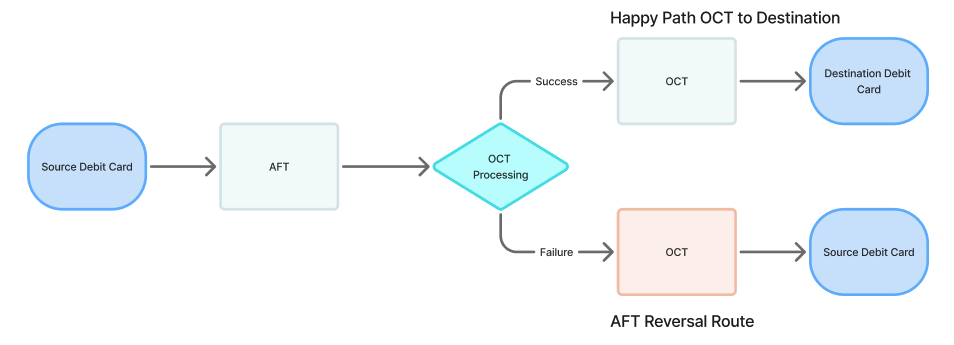
What you’ll see
When the reversal succeeds (the common case): the sender’s funds are returned to their source card automatically — no action is needed from your team or the end user. The parent transfer status remains as failed and the reversal transfer segment status will be processed.
When the reversal itself fails (less common): Astra’s payment operations team monitors for these failures and will alert your team directly so you can help the end user resolve it.
Resolving a failed AFT reversal
If Astra notifies you of a failed AFT reversal, you have two options:
Notify the end user directly and return their funds using another method.
Contact the destination card provider to check whether the card is locked, inactive, or has another issue that can be resolved. Once it’s fixed, contact Astra Support to retry pushing the funds to the destination card.
Telling an AFT reversal failure apart from a normal decline
A transfer can also fail for reasons unrelated to AFT reversals — most commonly, a standard debit network decline.
A decline_code is only populated in the metadata of a transfer_updated webhook when that webhook was dispatched from an automated AFT reversal.
If decline_code is present, the failure came from an AFT reversal rather than a standard decline.
Regardless of AFT reversal outcome, if the original transfer status will remain failed. This is due to the original route of source debit card to destination debit card failing.
FAQ
How will I know if an automated AFT reversal fails?
Astra’s payment operations team monitors for AFT reversal failures and will alert your team when one happens.
What should I do once I get that alert?
Notify the end user and return their funds another way, or work with the destination card provider to fix the card issue and ask Astra Support to retry the OCT.
How do I distinguish an AFT-reversal-related failure from a normal decline?
Check for a decline_code in the metadata of the Transfer_Updated webhook — it’s only populated for AFT reversal failures.
Technical reference: transfer & routine lifecycle
For engineering teams building automated handling — documents the exact webhook sequence and status values for both outcomes.
Scenario 1: AFT reversal succeeds
Routine is created — no webhook sent.
Transfer is created — transfer_created webhook sent.
AFT is processed, but the OCT fails — transfer_updated webhook sent; transfer status is now failed.
Routine is completed — routine_updated webhook sent; routine is now failed.
AFT reversal succeeds (OCT reversal is now
processed) — anothertransfer_updatedwebhook is sent.Transfer status and routine both remain
failed.The
transfer_updatedwebhook will contain a metadata component with details on the reversal.Example:
{
  "reversal_status": "processed",
  "decline_code": "61 - Exceeds approval amount limit"
}
Scenario 2: AFT reversal fails
Routine is created — no webhook sent.
Transfer is created — transfer_created webhook sent.
AFT is processed, but the OCT fails — transfer_updated webhook sent; transfer status is now failed.
Routine is completed — routine_updated webhook sent; routine is now failed.
AFT reversal fails (OCT reversal is now
failed) — no additional webhook is sent.Transfer status and routine both remain
failed.Astra's Payment Ops team will review.